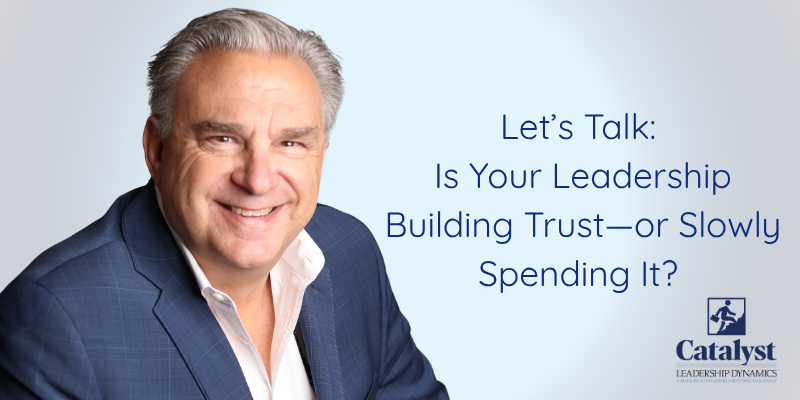
Is Your Leadership Building Trust—or Slowly Spending It?
Personally. Professionally. Organizationally.
Catalyst Framework
Trust is not created in one magical leadership moment. It is earned—or weakened—through a daily body of work. At Catalyst Leadership Dynamics, we believe how we behave matters.
Our words reflect our thoughts. Thoughts influence beliefs. Beliefs drive behavior. And behavior ultimately determines whether others grant us trust and results are earned.
This is where the Catalyst One-Degree philosophy becomes powerful. Improving trust does not necessarily require a massive organizational initiative. Sometimes a one-degree adjustment in how you listen, communicate, respond to conflict, or keep commitments can begin changing the entire trajectory of a relationship or team.
Why It’s Important
Trust affects nearly everything a leader is trying to accomplish. When trust is present, communication becomes more candid. Delegation becomes easier. Accountability becomes healthier. People are more willing to experiment, acknowledge mistakes, challenge ideas, and adapt to change. When trust is missing, leaders frequently compensate with control. More approvals. More meetings. More checking. More rules. More involvement. The result? Leadership becomes heavier and the organization becomes slower. Culture suffers.
Trust does not mean the absence of accountability. In fact, high-trust environments require strong accountability. People know the expectations, understand their responsibilities, and recognize that difficult conversations will occur when commitments are not met. Healthy conflict is not the enemy of trust. Avoided healthy conflict is.
How to Implement
For Novice Leaders
- Do what you say you will do.
Trust begins with consistency. Keep commitments, follow up, arrive prepared, and acknowledge when you make a mistake. - Listen before solving.
New leaders often feel pressure to have the answer. Ask questions first. Listen actively. Seek to understand before deciding what needs to happen. - Address small conflicts early.
Do not allow discomfort to create avoidance. A One-Degree issue ignored today can become a ten-degree problem tomorrow.
For Experienced Leaders
- Audit your systems for trust.
Examine meetings, approvals, delegation, communication, policies, and performance management. Are your systems creating accountability—or unnecessary control? - Invite people to challenge you.
Experience and title can insulate leaders from the truth. Surround yourself with people who have permission to respectfully disagree and identify your blind spots. - Determine what happens without you.
If every significant decision or problem requires your involvement, you may have built dependency rather than trust. Great leaders develop people and systems that work when they are not in the room.
Catalyst Conclusion
Trust is not soft. Trust is not accidental. And trust is never permanently earned. It is a daily leadership discipline built through hundreds of seemingly small behaviors. It is a journey.
Listen actively. Speak truth with candor and respect. Keep commitments. Resolve conflict. Remain authentic. Hold yourself and others accountable. Remember: Trust is not something leaders announce. Trust is something other people experience.
Catalyst Challenge
For the next seven days, ask yourself one question at the end of every workday:
“What did I do today that either earned trust—or spent it?”
Then identify one behavior you can improve tomorrow. Don't attempt to change everything. Make the One-Degree adjustment. Then repeat it.
Personally. Professionally. Organizationally.
That's how trust becomes culture.
Catalyst Leadership Dynamics | Business Tip Tuesday
This content is part of our: